










There is a tin pail of ash hanging on a nail in the doorframe with my name on it. Every day before I leave for the schoolhouse, I use the hard-bristled brush from the bucket to dust my dress, arms, shoes in darkness. My hands are covered in soot when I drop the brush into the pail. I smear it over my cheeks and the bridge of my nose.
My brothers and sisters do not use the ash because it is mine. I am my family’s darkness.
When I step into the sunshine, I can smell orange blossoms. It makes me sneeze, but I inhale anyway. One of my older cousins, Leena, waits for me outside. She takes my hand, ignoring the filth. I walk far enough away that my sooty dress won’t dirty hers, but close enough to keep hold of her hand.
The neighbor looks mean at me through her window when we walk by. I cannot look at her face, so I watch my boots instead.
The only sound we hear on the way to school is the whistle of wind through the groves and the crunch of gravel underfoot. Our steps are the same. The weight of our feet on the rocks is almost the same. We are almost exactly the same, but we’re not. I am the dark one, the wrong one.
I sit in the back of the schoolhouse, and Leena sits in front. She smiles at me and points to the seat next to her. I shake my head. That seat is not for me. Mine is in the back so no one has to look at my wrongness.
My best friend, Tareck, slides onto the bench next to me, a trail of soot maring the wood where he’s touched it. He is his family’s darkness too.
Our eyes meet, and we both smile at the ash on our faces. It isn’t a smile that makes merry. It only sees and likes to be seen. One day I want to grow bigger and learn how to make his wrongness go away. Perhaps there is a special school, a no-more-darkness school.
Sometimes my mind wanders while the instructor talks. I hear him when he speaks about shapes and numbers, but I cannot remember the story of our king he told us after lunch. I ask Tareck when we’re dismissed, but he says too many words, and I forget to listen. I hope he doesn’t notice.
Leena takes my hand and leads me through the center of town so we can buy taffy. The lemon one is my favorite. I eat five pieces, then search the crevices of my teeth with the tip of my tongue. I like that lemon taffy does not look like ash. I hope it doesn’t mind a dark one eating it.
Behind the general store, a stranger digs a well. His coveralls are tied around his waist and his flannel shirt is soaked through. Sweat drips off the orange hair falling in front of his eyes. Papa said that the man was asked to dig the well, but no one in town hired him.
I stop and watch beads of sweat fall from his hair into the hole. I want to get closer to see the bottom, but I don’t.
“He might be secretly bad,” my cousin says.
But he looks nice to me.
Leena tugs my arm, and I sigh through my nose. I want to watch him until I cannot see his orange hair anymore, like the sinking sun.
He looks up when I exhale and meets my gaze. He smiles. I smile back.
“Why are you digging a well?” Leena asks. “We already have one. Kingston has an aqueduct and—”
“This isn’t that kind of well.” He rests his arm on the top of the shovel.
“Not the kind of well that gives water to the town?” she presses.
He wipes his forehead on his shoulder. “Not that kind of water.”
Leena shifts her weight, then tugs my arm again. “C’mon, Fenn.”
But I slip my hand from hers and take a step closer to the hole. I crane my neck to see the bottom. “Is it a magic well?”
He cocks his head, thoughtful. “Something like that.”
“Does it grant wishes?”
“No. It’s for washing.”
My heart squeezes like Mama’s dish rag. “But—”
“C’mon, Fenn!” Leena grabs my hand, and drags me away.
Tears drip off my chin on the way home. I watch them fall onto the dirt and stones, imagining the bottom of the man’s hole looked just the same from his dripping sweat. We are almost the same, but we’re not. I am a dark one.
If it had been a wishing well, I would not need a no-more-darkness school. But maybe the magic water is not for wrong people who have wishes.
The neighbor is in her rose garden when I walk by. She glares at me, then moves her shovel and seeds closer to her. She thinks I am a stealer.
Inside, the house smells like baking bread. Papa kneels by the fire gathering soot in my bucket. He breaks up the chunks with the end of the brush. Then he hangs it on the nail by the door before kissing me on my head. I follow him to wash up in the small kitchen.
At dinner, I tell everyone about the strange man. When I get to the part about the wishing well, they all laugh at me. I do not finish the story.
When I finally rest my head on my pillow, I think about all the arithmetic I did not finish because my mind only had space to think about the magic well. The school master will use the paddle on my legs again, but that’s okay. I am used to the sting now. Dark ones always are.
***
The man is digging the well again today. If I crouch down, his neck looks like it is growing out of the ground like a stem.
“We don’t have time to watch him, Fenn.” Leena tries to drag me away, but I plant my heels in the gravel. “We’re going to be late for school!”
“Go without me. I will get the paddle anyway.”
She sighs and walks away, long brown braids swinging like ropes over her shoulder blades.
“Back again?” The man asks. He does not look up from his work.
I inch closer and kneel on the hole’s edge. The bottom is dotted with dark specks from his sweat.
I knew it. . . .
“Why are you digging the well? Leena says you are secret bad because no one asked you to dig here.”
The man laughs, but I do not think he is laughing at me.
“Someone did tell me to dig here, but they aren’t from this town.”
“Who? A wizard?”
“Nope. Better than a wizard.”
I inch closer so the toes of my boots hang over the edge. A few pebbles fall into the hole.
He looks up, and rests his arm on the top of the shovel. “What else is better than a wizard but a king?”
I gasp. “Does the king have magic too?”
“That’s right. Your king has a deep well of magic, and his very favorite thing is to share it with you.”
“But you said it was only for laundry.”
He laughs again, and it sounds like a dog’s bark. “I said it was for washing. Can you think of something you would like to wash besides clothes?”
I look at my hands, at the ash under my fingernails. Tareck’s face swims before my eyes. “Dark ones and wrongness?”
The man frowns. He looks at my smeared cheeks and dress. “What are dark ones?” His voice sounds angry, but gentle. Maybe it is not me that made his voice that way.
“Most families have a dark one.”
He cocks his head like Leena’s dog when he is confused.
“We must wear our darkness,” I say, “so that others will know we are loud, or slow, or forgetting. My papa gives me my darkness in a pail of ash, and I put it on. I am my family’s darkness.”
He jabs the tip of his shovel into the earth like a weapon. He does not look pleased. “This water won’t wash that away, because that isn’t true darkness.”
“But you said it washes—”
“Not your face or clothes or hair. When I finish this well, I’ll offer everyone in town a cup of the king’s water to drink. If they take it, it’ll wash the darkness from their heart, and they’ll be rightness.”
“The whole town won’t need it, because not all of them are dark ones.”
One of his eyebrows jumps up like it’s going to fly away. “You think so? Covering a child in ash to mark them for something they can’t control is something a dark one would do. Everyone needs the king’s water, Fenn.”
I clench my hands into fists. “What does it mean?”
“It means that no matter how much ash you put on, you will never be a dark one again if you drink this. But no matter how many baths someone takes, they will never be clean until they have tasted the water from the king’s well.”
“Can Tareck have some too?”
“Anyone who wants to be free of their darkness can have a drink from this well.”
I jump to my feet, and a cloud of dust rises between us. “I will come back.”
My feet raise clouds of dust all the way home. When I walk inside, the house is empty and all I hear is my own breathing. I snatch the pail from the doorpost.
That is not true darkness.
The ash billows like the dust on the road when I dump it in the fireplace. I try to smile, but I do not feel happy. Papa will be angry when he gets home. He will say that I am a selfish girl not to warn people of my wrongness.
I kneel to scoop soot back into the pail with my hand.
My name is on the tin written in ash. It belongs to me.
***
Tareck, two girls, and one older boy from school come with me to the well after supper. We are all dark ones. I asked the others why they did not want to be clean. They looked at me with anger in their faces and said they were not wrong like me. They do not need the king or his magic well.
Tareck and I lean over the hole where the man is now a foot below ground.
The shovel makes a funny slopping sound in the dirt like cucheh. Cucheh. Cucheh. Cuch—
A low gurgling noise springs from the bottom of the well like the first bubbles to break the surface of Mama’s corn chowder.
Water.
My hands and knees shake, but I am not afraid. Tareck smiles. He is shaking too.
The older boy named Cairn kneels next to us. He pulls a tin cup from his school bag and hands it to the man. “Can I have a drink now, sir? I don’t mind the dirt.”
The red haired man straightens and looks the dark boy over. “This water washes the inside, not the outside.”
Cairn dips his head. “Yes, sir.”
The cup fills with muddy water, and the boy drinks like he is offered fresh cider. It drips off his chin and speckles the dust under his bent knees. Cairn sniffs like he is trying not to cry. I wish he would so I could too.
The man refills the cup, and Tareck takes the next drink before passing it to me. I do not ask for it to be refilled before drinking the last swallow. Cool water and sand pass over my tongue.
I feel coldness seep into my ribs then stomach. It speaks with a gentle voice that my ears cannot hear.
“You’re rightness now, Fenn,” the well digger says with a grin as he takes the cup back to refill it.
“Thank you,” I whisper. My tight throat does not want me to speak anymore.
I turn and dart down the road toward home. The pail is there with my name on it.
It stares at me like it is mine. But I do not want it anymore.
Slowly, I slide it from the hook, wipe my name off with my sleeve, and pull the nail out of the frame with my fingers. It hurts a little.
The ash goes in the fireplace and the pail in the bottom of the garbage where no one will find it. I fill the hole in the doorpost with plaster so everyone will see the bright white spot where there used to hang a pail of ash. Father will be angry, but that’s okay. I am used to the paddle.
After I change my clothes and scrub my face, I walk outside so the trees and sky can see my clean face. The wind blows, and I smell the orange blossoms.
A hand grabs my wrist very hard. I look up. The neighbor is standing very close, and her round face looks like an angry bull.
“How dare you stand out here without your darkness!”
She drags me into her house. It smells like lavender and cats. I scrunch my nose. The neighbor unlocks the door on her black iron stove. She uses the little broom next to the stove to cover my dress in soot.
I try to pull away. “I do not want the darkness anymore!” I say. But she will not let go.
Once she finishes rubbing a scratchy coal over my cheeks, she shoves me out the door. “Don’t think I won’t tell your Father about this!” The door slams shut.
Tears dripping, I run down the road and into town. The man is there sitting on the side of the well. He looks at me when I sit by him.
“What’s wrong?” He asks with a frown in his eyes and his voice.
And I tell him. The wrinkle between his eyebrows gets deeper when I speak of the neighbor. I like to watch the freckles disappear into his wrinkled skin. It helps the tears stop coming.
“People can put soot on your dress, Fenn,” he says when I’m quiet, “but they can’t make you a wrong one.” He bumps my shoulder with his. The wrinkle is gone, and all his freckles are out. “Do you know why?”
I sniff and watch my feet dangle over the water in the well. I am not my family’s darkness.
“I am a girl of rightness.”
Photo by Mika Baumeister.
Have you read my book, Automated? Here’s the place to read and write reviews! Scroll down to the comment section to leave an honest review.
If you haven’t read the book, subscribe for my newsletter, and I’ll send you a copy for free!
What’s the book about? I’m glad you asked! Automated is a steampunk Pinocchio retelling. Here’s a description!
In a world where every person is born an automaton, enslaved to their gears like a clock to time, Nico only wants to be free.
He was disassembled and discarded with the garbage—the kind of treatment a mischievous orphan like Nico has come to expect . . . until the day the clocksmith, Hubert, reassembles his broken mechanics, calling him son. But with Hubert’s rival, Rigar, and Nico’s penchant for trouble, the fragile new family is ripped apart.
On the run from Rigar’s goons, Nico must learn to lay down his pride and accept the help of the invisible Mechanic if he’s ever going to be a real boy. Will Nico escape his own lies and find the freedom to live with a heart of flesh?

For a little over a year now, our family has been living near Palm Springs, California where my husband, Tim grew up. If you haven’t heard of it before, well . . . it’s a desert. And this year has been particularly hot, reaching record high temperatures. We’ve prayed for rain, but the Lord has not seen fit to send it until this weekend. It’s been more than two hundred days without rain.
Well it didn’t exactly pour, but the temperatures plummeted into the 40s at night, and we felt a little sprinkling during the day on Saturday, November 7—the day Joe Biden and Kamala Harris were confirmed as president-elect and vice president-elect.
This morning as we drove to church, the sky was clear over the desert, but rain clouds were visible over the mountains as we headed west on the freeway. A rainbow on the north side of the road, low to the ground and shining brightly, was covered by a drifting brown cloud from the south side. It was a strangely beautiful image, marred by the presence of smoke.
As we drew closer, the kids stared, yelled, pointed at the fire to our left. We could see a few flames and billowing smoke amongst the desert’s windmills. “But look!” I called back. “Look at the rainbow! It’s so bright, and now it’s a full bow. It’s touching the ground on both sides!” To our right was a breathtaking sight as every color stood out in all its glory, and the top of the bow was even shorter than the nearby foothills.
But they wouldn’t give it more than a cursory glance.
“They’re too distracted by the fire,” Tim said. And he was right.
After another attempt to turn their attention away from the smoke, I gave up. What was a rainbow next to such a disaster?
We drove between the mirrored sights, the irony of it not lost on us.
It occurred to me as the car was soon covered in dark rain clouds beyond the mountains, that we’re all just like my children right now. Whether you are celebrating the victory of our new president-elect or mourning, it doesn’t really matter. We have convinced ourselves that this election means everything for our country. We have bought into President Trump’s line that this is the most important election of our lives. But this is not true. We are distracted by disaster. If your disaster has been the last four years, that is a distraction. If your disaster is the next four years, that is also a distraction.
Do not turn your eyes away from what is right in front of your face. God controls the rain, the wind, the heat of the summer. He ordains presidents and nations, and nothing happens outside of his plan. Not only is he sovereign and will bring about judgement for all of our disastrous sin in the end of time, he will intervene now. He will discipline and show mercy even now. He is constantly sending down rainbows and blessings as a reminder of his faithfulness to keep his promises, but you will never even know they’re there unless you look away from the disaster surrounding you.

I adjusted the chains across my back. Rusted links the size of magnolia leaves slapped my legs when I moved. A groan slipped past my lips as the metal dug further into my shoulders.
Hand shading my eyes, I glanced up the hillside toward the gate at the top—wooden with an iron ring instead of a knob. Towering hedges spread out from the door as far as the eye could see. Gray clouds dusted the sky beyond the hill.
I needed to get through that gate.
My feet moved forward—one step. Two. Three. . . .
With every bend of my knee, every pad of my foot on the grassy hillside, the chain bit into my flesh, orange rust staining my white t-shirt.
Just one more step.
Okay, now another.
Another.
The links slipped on my shoulders, so I looped them around the back of my neck like a scarf. I winced as they pinched the tender skin on my throat.
Don’t stop, don’t cry. Just take another step.
The wind picked up, and I glanced at the gate again. It didn’t look any closer. Could it be a mirage? Didn’t those only exist in the desert?
The breeze carried the scent of salt water. How strange. . . . There was no water to be seen. But it didn’t matter. Only the gate mattered now.
Just keep walking up the hill and don’t think.
I shifted the links, and my hands came away covered in corrosive rust. My back ached. I didn’t know how long I could go on like this before I had to stop and rest. Would I be able to stand up again?
In front of the gate, a frothy white wave rose into the air out of the base of the hedge. My breath caught in my chest. Panic seized my body as though every limb was encased in a Chinese finger trap.
The monstrous wall of salt water curled at the top, then slammed into the grass only yards in front me. I leaned backward, the weight from the chain pulling me down the slope. I stumbled, but didn’t fall. There was nowhere I could go, nowhere to run, even if I was able to move quickly with this burden.
In mere seconds, the wave was upon me, swallowing my form like the fall of a pebble in the ocean. Ice cold water pricked my skin like a thousand pins. I held my breath and tried to kick up to the surface. But burdened as I was, my body only moved down. My lungs burned from lack of oxygen.
As I tumbled, the chain wrapped itself around my limbs like a snake with a mind of its own, cutting into my arms and neck.
I opened my mouth to scream. Salty brine rushed in to silence my terror.
Then the water filled with voices.
Their scorn, my shame pressed down on me along with the pressure of the wave. The sound was familiar. I knew those voices and remembered their words. With every syllable, the weight of the chain encircling me grew heavier.
And there was nothing I could do to make it stop.
Dear God, help me!
Shadows whispered on the edges of my vision. Instinctively, I tried to draw breath, but only filled my lungs with more water. I flailed and kicked against the water, the chains, the hopelessness of it all.
Then my feet touched solid ground. First my toes, then my heels settled. But instead of spongy, wet grass, I felt something hard underfoot.
Water peeled away from me, and a single ray of sunlight pierced the shadows to kiss my brow.
I coughed and retched water from my lungs, blinked the salt from my eyes.
Through the haze of water still clinging to my lashes, I could just make out glass stairs beneath my feet. Although they felt like stone, my chain fell through the glass like . . . water.
I blinked droplets off my lashes. The stairs weren’t glass at all, but the wave itself.
“Walk,” said a melodic voice somewhere above me.
Coughing, I said, “I w-want to, but I can’t.” I lifted the chain encircling my arms. “It’s so heavy. . . . And the gate never gets any closer.”
“Walk,” he said, all the more coaxing and kind. The sound seemed to thrum inside me.
I bit my lip, and took a tentative step forward. Again, I landed on something solid. Yet the link that fell through the surface of the glassy stair disintegrated—rusted orange particles dancing in a salty swell.
I took another step forward, the sun’s rays spreading across my face as each link in the chain brushed the surface of the water and fell away.
The gate, once unmoved, drew nearer as I climbed. Warmth blossomed over my form, beginning at my head and moving into the center of my chest.
The last few links in my chain crumbled in a gust of wind as I stood at the top of the watery staircase. Orange dust lingered in the air around me, sparkling in the blazing sun, before dissipating.
I released a shaky breath, overwhelmed by the majesty of what lay beyond the barrier.
With two hands, I reached for the iron ring and pulled.

In Dr. Seuss’s book, Oh the Places You’ll Go, there is a waiting place—a “most useless place.” Where people of all shapes and sizes are “just waiting.” In Seuss’s defense, he was implying these people lacked initiative to do something with their lives. But despite the truth of that, God still keeps us in that place at times. In a recent sermon, my pastor Mark Rogers said, “. . . when it comes to God, the waiting place is never a useless place. God gets so much done in the times that he has us waiting.”
Many of us feel the tension of the waiting place right now—whether still in partial quarantine, searching for a new job, or waiting for schools to reopen. God knows waiting for future grace is difficult. That’s why he instructs us not only to have patience, but courage. Psalm 27:14 says, “Wait for the Lord; be strong, and let your heart take courage; wait for the Lord!”
The Bible often uses words like strength or courage when discussing waiting (Jas. 5:8, 11; Is. 40:31; Ps. 33:20; Col. 1:11). If courage is strength in the face of fear, what does that have to do with waiting? If we’re honest with ourselves, we’d see that fear is a vice that often accompanies waiting—a fear of future suffering, of not being in control, or even of what God might bring. But the Lord tells us, “let your heart take courage” (Ps. 27:14) because our God can bring goodness from any amount of suffering, present or future.
During my husband’s job hunt, he often reminds me that God is cooking, and we must wait. We can smell the feast he’s preparing for us, and it only makes us hungrier. In that time of eager waiting, our faith is increased because we know God will be good to us—we can smell the food! We’ve eaten of his blessings before, and can almost taste what’s to come before it arrives. With such eager longing to experience God’s goodness in this world and the next, is it surprising how much courage is needed to stay in the waiting place?
I enjoy experimenting in the kitchen, and my three year old, Peter, likes to help. A couple months ago, Peter and I were preparing falafel patties when I turned away for a second, telling him not to touch anything. When I turned back, he’d dumped half a bottle of lemon juice into the bowl of chickpea flour. Had I not immediately poured off the juice, the whole thing would have been ruined.
I love how eager he is to help, but at his age, I can’t look away for even a moment in case he decides to continue cooking without me. He thinks he knows what needs to be done, but he ends up ruining the food instead.
We are often like a small child when God is preparing a way for us—eager to fix when we’ve been told not to touch. But in the waiting place, all our efforts and plans will fail or produce sour consequences.
Another Peter struggled with putting his own plans above those of his teacher. In Matthew 16:21-23, Jesus tells his disciples about his death and resurrection. “Peter took him aside and began to rebuke him, ‘Oh no, Lord! This will never happen to you!’ Jesus turned and told Peter, ‘Get behind me, Satan! You are a hindrance to me because you’re not thinking about God’s concerns but human concerns’” (CSB).
Peter was essentially saying, “You may be the Messiah, but I still know better than you. What you’re saying will never happen.” Such sentiment deeply lacked faith, which is why it produced such a strong rebuke. Peter must have been shocked by Christ’s words. Perhaps he thought he was somehow loving Jesus by saying he wouldn’t die in such a way.
Perhaps we also think our intentions are good when we refuse to wait and submit to God’s plan. Instead it shows that same lack of faith as Peter.
I’m a fixer by nature. When there’s a health or developmental issue in my family, I won’t stop searching for a solution—even if it takes years. Sometimes my persistence produces good results. But at other times, I push past every dead end God errects in my path. In the end, I have to repent and deal with the consequences of my scheming and lack of faith.
Rogers said, “There are things that only God can do, and so we often find ourselves waiting on him to act. . . . We all know that waiting can be hard, right? It’s much more natural to try to make things happen ourselves—to push, and plan, and scrape, and sometimes even manipulate in order to make things happen.”
What would it look like to have faith when your life is characterized by waiting? It wouldn’t look like obsessive hunting on the internet. It wouldn’t look like hovering over all your problems feeling hopeless. It would be prayerful, courageous, and faithful. “The Lord is good to those who wait for him, to the soul who seeks him” (Lam 3:25). If you’re in a season of waiting, God is preparing a feast. His goodness and faithfulness will never fail.

The Southern Baptist Convention 2019 was a momentous occasion. Not only had I never attended before, but everything from the resolutions to the panels to the coffee dates were alive with the whirlwind of change.
Sexual abuse.
Racial reconciliation.
Women’s roles in the church.
No one was afraid to talk about the SBC’s dirty laundry. We didn’t always agree, but that was okay. We talked about all of it in painstaking detail and invited the whole world to watch. Then we voted that sexual abuse and racism were grounds for expelling churches from the convention. And I couldn’t be more proud of our leadership for their humility and resolve in these areas.
While remaining steadfast in conservative, Biblical principles and complementarianism, I saw men—leading men—affirm the value and voice of women in the church. At the SBC Women’s Leadership event, our president, J.D. Greear, expressed his excitement about the new generation of women and change we are ushering in. And while he was glad for what has already taken place, he reminded us that we are only starting to scratch the surface.
The SBC (along with other conservative denominations) are just beginning to see the effects of the minimization of women in churches—especially in the South where legalism over leniency is more common. And I would have to agree fully with Greear—there is much to be done, not primarily in the convention but in church culture.
I was in a state of awe during the convention. There was so much to see, hear, learn, and read. I couldn’t have done it all if I’d wanted to. And I was just so darn happy to see change finally taking place in so many areas, I didn’t immediately feel where it was still lacking. But as we drove out of town on Thursday morning, I finally put my finger on it.
No one asked me what I do.
You know those moments when you get stuck at a table with a bunch of people you don’t know? You’re forced to make small talk, ask where they’re from, what they do, how many kids they have. But people in the church don’t ask women what they do unless they’re alone.
I asked my husband how many times he had a chance to tell someone he’s a philosophy professor and PhD student. It was so many, he’d lost count. When he asked me the same, I recounted the one time I told someone about my various writing endeavors—at the women’s leadership event. It was at a place where there were no men at the table and women only had eyes and ears for one another.
That realization stung deeply. All the implications crashed down around me. I could list all the reasons why they ask him and not her, but there was one that stuck out to me above all the others: they already knew. Or they thought they knew, and they didn’t care to know more.
All the people at those tables and booths subconsciously assumed I was a stay-at-home mom and my husband had a real job. And I assumed right along with them. Don’t think I’m trying to be high and mighty in my critique here. You can bet I did it too. I am guilty of not wanting to hear about other women’s kids and schooling choices because I think (wrongly) that it’s boring and ordinary. Nor do I immediately assume they have something they do outside the home or in their spare time. It’s not something I would ever have admitted to until now since it’s mostly subconscious.
But here’s the thing—I am a stay-at-home mom. My husband really does have a job outside our home. I change diapers, cook the food, fold the laundry (sometimes), and then some. And all those things are extremely important. There were seasons—and rightly so—of my life where that is all I did, and all I was able to do because my kids were little.
But that isn’t the whole story for me. I am a woman who loves the church and the people in it. He has gifted me as well as every woman to serve his church in some capacity. He has gifted you, sister, to serve the body for the sake of the kingdom.
I have things that I do apart from my family. And if we were honest with ourselves, we look a lot more like the Proverbs 31 woman than we usually give ourselves credit for. We care for our homes, our families, start businesses, use our teaching/serving/leading gifts in a multitude of venues, and pretty much git it done.
I know a lot of men in SBC churches who think very highly of women. Some of them even read theology books written by the opposite gender. But I can’t help but wonder if they would think to ask that woman, the one sitting at a table with her husband, what she does.
This is a glorious season of change in the church. Let’s all work together for the sake of the gospel.

**Click here to read Part One**
Overcorrecting Subculture
I’ve lived in four different states in the US and visited ten countries around the world. God has been gracious to show me how different cultures and subcultures can greatly impact the way we live out our faith. I want to focus on two specific cultures that I have the most experience with: First, where I was born and raised in Southern California, and second, where I have lived the last eight and half years in the Bible Belt of the South (Kentucky for six years and Texas for two and a half).
As I’ve said, it is human nature to overcorrect problems within our subculture. There are two main ways we do this as individuals. First, we observe the subculture around us and think that it is right, then demonize and stereotype people outside of it. Here are some overly simplistic examples: “Southern California is so much more enlightened than most of the US. I’m so glad I don’t have to live in the South with all those racists and fundamentalists.” Or, “The South is so much more grounded in its history and the Bible. I’m so glad I don’t have to live around all those crazy liberal feminists on the West Coast.”
The second way we overcorrect is to observe the subculture we live in, think it’s wrong, and then jump ship entirely, usually into a very different subculture with it’s own set of problems. Here are some examples: “Southern California is way too progressive and the churches are so shallow. I wish we could go to one of those churches that sings only hymns, offers Sunday school, and has a potluck after service every week.” Or, “The South is so legalistic and they hate women. I wish I could go to a more inclusive community in California where I can serve anywhere or teach anyone.”
These examples are trite, I know. But you get my point. No culture is perfect because everywhere you go, there will be sinful people there. There will be sinful you there. Yes, sometimes the answer to a problem is to jump ship. God can use discomfort to call you away from a place. But just because you’re uncomfortable doesn’t mean it’s time to quit. This is where temperance, critical thinking, and more importantly prayer comes in. Temperance is needed to say, “I know there is a problem with my community but I don’t want to throw the baby out with the bath water and think the solution is doing the exact opposite.” Critical thinking is needed to ask questions like, “I feel like there is nothing good about my community, but I know that can’t be true. What is good and what is bad? What is salvageable here? What needs to go?” Prayer can enlighten your path more than any virtue or critical thinking ability. There will be times when your options ahead look perfectly equal and you really have no idea what to do. Thank God for his Spirit that directs our hearts and minds toward wisdom.
Temperance and Secular Culture
How far is too far to participate in secular culture? How far is too far to pull out? Can I let my kids read Harry Potter? Should I go live on a farm in the middle of nowhere to escape secular culture?
I’m not actually going to answer any of those questions specifically. But I do want to talk about one of the virtues we use in answering these questions (and others) for ourselves and our families.
This is an age old conversation, but an important one. First let me quickly define some terms!
Temperance: The ability to moderate your actions. Most Bible translations refers to this as “self-control” in the lists of the fruit of the Spirit.
Virtue ethics: Focuses on the virtue or moral character—the heart, dispositions, and habits—of a person rather than on external actions and duty (deontology). We can see this in scripture in many places, most notably in the Sermon on the Mount.
Aristotle’s Golden Mean: Virtue is the mean between two extremes—the opposing ends being vices of excess and deficiency. This principle can be seen many times in the Bible when it talks about not turning aside. Such as Deut. 5:32, “Be careful to do as the Lord your God has commanded you; you are not to turn aside to the right or the left.”
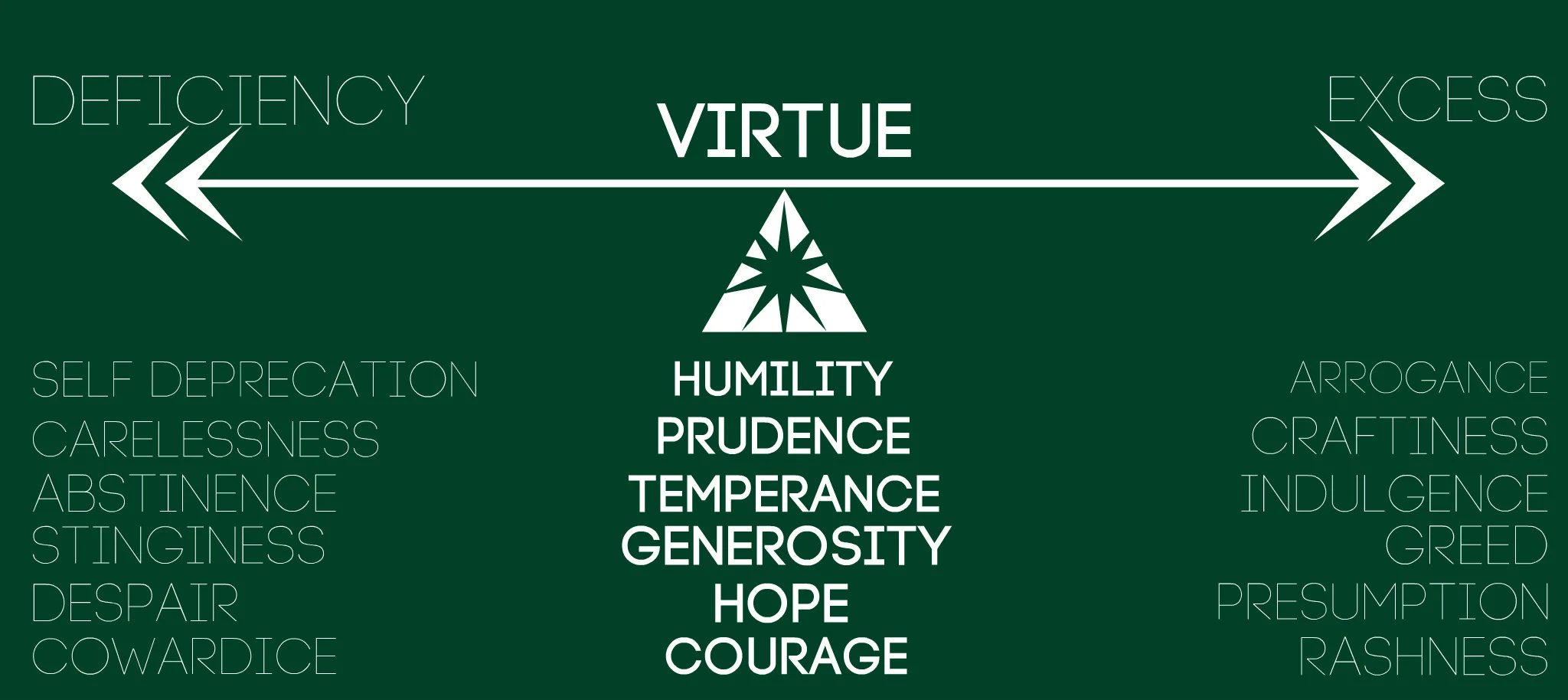
There are two common dispositions towards American culture that I see in the church at the moment (and for all time really, but I’m going to speak only into modern, western society). One is unrestricted (or nearly) indulgence in secular culture which can lead to further sin and idolatry. This is the “excess” side of the golden mean scale. The other is total (or nearly) abstinence from secular culture which often leads to legalism and self-righteousness. This is the “deficient” side of the golden mean scale. Both are vices, not virtues.
Now, I know what some of you are thinking at this point. Most orthodox Christians attempt to find a balance between participation in and abstinence from culture. We don’t always draw the line in exactly the same place. I would agree with that. It’s even a good thing that we don’t all make the exact same choices with our cultural diet because some disagreement, as long as it is civil, builds up the body of Christ.
So then, why say those vices (a lack of temperance) are common? Although it is generally known that we should find balance with our participation in secular culture, there’s real confusion about how to express such temperance. Confusion comes from our evaluation of our subculture and the human tendency to overcorrect when we see a problem. More on overcorrecting subculture in Part Two.
Christians are not taught how to think critically. Most evangelical seminaries do not even offer classes in the basics of philosophy (i.e. critical thinking, logic, metaethics, etc.) whereas Catholic and Orthodox seminaries require them. (Rabbit trail: Why is that important? I could go on and on about that, but I’ll keep it simple. Lest you think “human philosophy” is all evil, recall that logic is a kind of science that says if A and B contradict each other, they can’t both be true. Seeing as God does not contradict himself, it’s safe to conclude that God is logical, and we should strive to be as well. We should not believe contradictions.)
Our church congregants as well as our church leaders typically have no training in how to think critically. And how can we rightly discern the balance of such things as cultural involvement without those skills? We usually don’t. We overcorrect into vice which leads some to cultural indulgence and idolatry and others to cultural abstinence and legalism. Then we sit back and judge those who overcorrect in the other direction. Without temperance, we will not only fall, often unknowingly, into vice, but we will have a complete lack of grace for others who simply fall differently.
Let me give you an example of these two things.
Indulgence (excess vice): The community of Christians who write and read science fiction and fantasy, like myself, varies widely. There are those who make great effort to think critically about how far they should go with their writing and reading and how closely it should resemble that of the secular market. Then there are others who, upon seeing the problems with abstaining from much of pop culture, delve headlong into the fantasy world without restraint. Some of their fiction includes sex and the use of explicitly dark magic by protagonists. They see themselves as critical thinkers because they dodge the bullet of “legalism.” Yet, in their new found freedom from fundamentalism, they display an utter lack of critical thinking against indulgence, seeing it as good or the lesser of two evils. Cultural indulgence in general is prone to either deleting parts of scripture or twisting the meaning to fit certain needs. By some of these well intentioned readers and authors, I have been accused of being a fundamentalist due to articles like this one that tell of my position on sexual purity. (Not to be confused with the purity movement which uses shame to keep young people from premarital sex.)
Abstinence (deficient vice): In some circles I run in, lifestyles such as homeschooling, stay-at-home moms, and even patriarchy are commonplace. For the right family and the right child, homeschooling is prudent. And not only am I a stay-at-home mom, but I think it’s a blessing for any mom to be able to stay with their child when they’re an infant and toddler. Yet, where the indulgent delete or twist scripture, the culturally abstinent tend to stretch the commands of the Bible like silly putty so that they are no longer recognizable. For example, Proverbs 22:6 says, “Train up a child in the way he should go.” This becomes the basis by which they advise others that public school is inadvisable or even immoral. Worse is the petrifying fear within the American conservative community of radical feminism. The overcorrection against such liberalism can be drastic and horribly unbiblical. Was the baby not thrown out with the bathwater by Paige Patterson, former president of a Southern Baptist seminary, when he advised a female student who had been sexually assaulted not to go to the police? In this conservative subculture, I have been labeled by some as erring in indulgence due to my stance on women’s roles within the church because I affirm their need to use their God-given spiritual gifts in accordance with scripture. Their role should not be defined by Bible-belt culture. Ironically, this view is shared by at least some professors at the theologically orthodox Southern Seminary.
I point out how I have been labeled by these subcultures not to merely complain or to show that I must be in the right because I think I fall in the middle of the two and, therefore, must have the virtue of temperance. But, instead, I want to illustrate that they can’t both be right. We can’t all be right, especially when we believe such contradictory things. I said before that disagreement, as long as it is civil, builds up the church. We must have temperance paired with grace if we are to flourish in unity. Knowing that it is in our nature to overcorrect into vice, grace is required for others who do the same in a different direction.
Pray that God grants his people temperance, wisdom, and understanding in this area. Ask also that we would learn to be more gracious to our brothers and sisters who are different from us.

The New York Times released an article this week about an African-American teenager forced to cut his hair, styled in dreadlocks with a cap over them, or forfeit his wrestling match. He chose to cut his hair. The article, not the teen, stated that he should not have to forgo part of his identity in order to continue the match.
The language in the article disturbed me. It wasn’t the teen who was using it but someone imposing that particular sense of identity on him without his consent. Perhaps he does consider it part of his identity. We may never know. But what disturbed me the most was that the way the author of the article uses “identity,” although normal for our society, was wildly ambiguous.
What is my identity? Who am I? Is my cultural identity the same as my individual human identity? Can I still be me if I’m stripped of my culture?
The word identity is often thrown around in these ambiguous terms. My appearance is my identity. My hometown is my identity. My gender is my identity. My church is my identity. But is this helpful? Does it diffuse racial tension or infuse it?
This is especially important for the Christian. Our individual identity is in Christ first before anything else. We should not be demanding of others to understand us whether they are unbelievers or weaker brothers and sisters in Christ. As Paul says in 1 Corinthians 9:19-23,
“Although I am free from all and not anyone’s slave, I have made myself a slave to everyone, in order to win more people. To the Jews I became like a Jew, to win Jews; to those under the law, like one under the law—though I myself am not under the law—to win those under the law. To those who are without the law, like one without the law—though I am not without God’s law but under the law of Christ—to win those without the law. To the weak I became weak, in order to win the weak. I have become all things to all people, so that I may by every possible means save some. Now I do all this because of the gospel, so that I may share in the blessings.”
As unpopular as this opinion may be, I am not my earthly culture. Culture, although important in many ways, is not something I will take to heaven with me. It is temporal and I am eternal, made to commune with Christ forever in heaven.
Right about now I probably sound like a know-it-all white evangelical who likes to tell other people who they can or can’t be. But I’m actually attempting the opposite. While keeping in mind that all cultures are flawed in some way, cultural identity should still be celebrated. The teen with dreadlocks shouldn’t have to cut them because of someone else’s cultural preferences. (Whether he actually broke a real rule by having long hair is moot because I’m trying to make a point here….)
To understand this better, I will give another example of evangelicals rudely butting into culture—one which I am passionate about: worship styles. It is so common, especially among my own people (the young, restless, and reformed), to tell people how to worship. “Don’t be too loud, it’s not a show!” “Your smoke machine is too distracting.” “Hymns are the only thing you should be singing.” And my personal favorite as it directly contradicts the example set for us in the Psalms: “Don’t sing any song that’s repetitive!”
Should we not celebrate our culture differences (as long as it does not contradict the Bible’s direct or implied teaching) with something that is as personal as music? Should we not worship God in our own musical, mother language? It is not wrong to play your music loud. It is not wrong to keep using the organ and singing hymns. It is not wrong to dance and shake a tambourine. It is not wrong whip out the synthesizer on a Sunday morning. Worship is a celebration! Celebrate in a way that best communicates your love for God. Celebrate in your own culture, and when need be, gladly celebrate in someone else’s culture for the sake of the gospel.
Cultural identity is much like listening to my favorite style of music. Or better yet, worship music done in my favorite style of music. It can make me dance, cry, or wrap up in a warm blanket with a cup of tea. It feels like belonging.
That’s what the author of the article is talking about when he says that boy was forced to forgo his identity in order to compete. And that’s why it was so offensive. It was like stripping him of his sense of belonging—stripping him of his cultural identity. What he was not stripped of was his value—his innate human worth. Cutting his hair did not literally devalue him as a human being. With or without his dreadlocks, he is made in the image of God and has just as much value as a fetus, a small child, a teenager, a middle-aged man, an elderly man dying in a nursing home. He is always valuable because his individual identity is as a human being made in the image of the almighty God.
But what if the man who forced him to cut his hair really was a racist and was attempting to devalue him? That’s an important question. And it begs another—is every racist act committed, whether purposeful or not, an attempt at compromising another person’s value as a human being? Or is it disrespect for their cultural identity—their appearance, music, hometown, etc.?
You may be wondering why it matters. Racism is racism! It’s all bad! Well I think those categories do exist and they matters because, at least for me, it helps to have specific questions to ask myself in order to root out my own sin. As the song goes, “Everyone’s a little bit racist sometimes.” And if I don’t think rightly and specifically about my sin, how can I find it and, as John Owens says, mortify (kill) it?
Questions I can ask myself (or others) in order to know my heart better:
Do I think I am better than that person? Do I actually believe I have more value than someone else? If so then I am calling into question their human identity given by God.
Do I think my cultural preferences are superior to someone else’s? Am I imposing those preferences on them when I speak to them or advise them? If so then I am being disrespectful of their cultural identity.
Does my life invite the celebration of other cultures or do I make them uncomfortable by being narrow minded or willfully naive?

This year’s reading was a little different for me. I normally read a far greater number of fiction books with only a few non-fiction titles. But knowing my weakness in this area, I decided to forgo all fiction (outside of my own writing) during Lent. I needed that time to reset my mind and habits. I also used the “Reading Challenge” feature on Goodreads to help track my books for the year and discourage random seasons of booklessness. Out of 46 books read, here are my top ten of 2018!
Fiction
Wayfarer by K.M. Weiland (5 stars)
I’d been anticipating this book ever since reading a tiny blurb about it years ago. 1700-1800s is my favorite time period and superheroes are my jam. I also knew K.M. would do it right. And she did not disappoint! She definitely did her homework for the period and the characters were well developed. Out of all of her novels, this is probably my favorite (although tied with Behold the Dawn). I highly recommend this to anyone who loves historical fantasy/superheroes.
The Electrical Menagerie by Mollie E. Reeder (5 stars)
Wonderful genre bender! Reeder infused The Electrical Menagerie with elements from steampunk, fantasy, science fiction, and murder mystery. I loved that the world and tech was all simple (mostly--I was a little confused about the stars and what they had to do with religion and politics) but still quite unique. The characters were lovable and had real depth. I originally read this book as research for my own writing about automatons, but I will keep reading this series for sure.
The More Known World (#2 in Oddfit Series) by Tiffany Tsao (5 stars)
Despite the author’s occasional (intentional?) shirking of modern storytelling *rules* I love her. I love this series. I love love love LOVE it! If you are a fan of a Hitchhikers Guide to the Galaxy sense of humor and a love of awkward people, you just might adore this book (series) as much as I did.
Keeper of Shadows by Bridgett Powers (4 stars)
Christian epic fantasy anyone? This is a classic fantasy setting (including setting, verbiage, and classic mythical creatures such as faeries and unicorns), but the use of "magic" in this world is forbidden by the King--as in scripture. A delicate balance is struck between fulfilling reader expectations for the fantasy genre while simultaneously staying true to commands in the Bible regarding sorcery. The prose was gorgeous and free from common commercial ailments. The characters, especially Brennus, were well developed and grew slowly, and believably over the course of 500 pages. I’m looking forward to the next book!
The Gateway Chronicles by K.B. Hoyle (4 stars)
I reread this series this year because the author rereleased it with some edits including a couple new scenes. She’s even beginning to release it on audiobook! Exciting stuff! It’s been one of my favorite Christian YA series for time and I loved delving back into the world of Alitheia with Darcy and Tellius!
Honorable mention: Frankenstein by Mary Shelley
Non-Fiction
On Reading Well by Karen Swallow Prior (5 stars)
Okay so technically I haven’t finished this book yet. But that doesn’t change the fact that it is one of the most wonderful things I have ever read. And some of my reasons for saying that are very personal. Not only is this book about reading fiction (my heart!) but it’s about reading fiction with purpose and for the sake of Christian virtue (more on why virtue ethics is personal for me in a sec). I have long been discouraged by the amount of modern secular and Christian fiction on the market that seeks to entertain (and even torture) readers for the sake of writing thrilling page-turners. Although this book is about reading well and not specifically writing well, I think the Christian fiction writer can pull a lot from it too. And now regarding virtue ethics! My husband has been studying that branch of ethics for over ten years with the desire to see more people in the protestant church adopt it. We both feel God has called us to serve the church. One of the ways we hope to do that is through the teaching of virtue ethics—he in a classroom and me with my stories (which may one day see the fluorescent lights of a bookshop). I’ll need to stop there before I write an entirely new blog post. Basically I think this book is super important for more reasons that I can say! Read it. And then give it to someone else to read.
Humble Roots by Hannah Anderson (5 stars)
This might be my new favorite book on humility—or perhaps tied with The Freedom of Self Forgetfulness. What this has over Keller’s is thoroughness, and (IMHO) a slightly more accurate definition of the virtue. But I could be wrong. (Shrug.) I would highly recommend this to anyone looking for a deeper understanding of humility.
Lit! by Tony Reinke (5 stars)
This book was EXCELLENT. Even writing this at the end of the year, I feel like I need to reread it already. Reinke gave a theology of reading along with some very practical thoughts and suggestions. . . . I could go on and on. I loved this so much that I wrote one of my Lorehaven articles based on one quote from this book. If you’re a Christian and you like to read, don’t like to read, don’t like to read but wish you liked to read, then this is for you!
Women and God by Kathleen Neilson (5 stars)
This book was wonderful and timely. I have perused other books on women lately only to be disappointed in their treatment of scripture. Nielson's theology, application, and understand of women's inner workings was on point. She was fair, but critical. She did not throw the baby out with the bathwater (my pet peeve....) I bought this book in kindle format but now I'm going to get it in paperback so I can loan it out. If you're swinging on the pendulum of women's issues in the home and church, READ THIS BOOK!
All That's Good by Hannah Anderson (5 stars)
Two books from Hannah Anderson made it onto my top ten this year! That’s only because I haven’t read her third book yet. Expect that to show up next year! I had a hard time getting into this one, but the pay off was well worth it. I especially enjoyed the last chapter on the spiritual gift of discernment. I will highly recommend this book for a long, long time!
Honorable mention: The Gospel comes with a house key by Rosaria Butterfield

Review of Christians in the Crosshairs: Persecution in the Bible and Around the World Today by Gregory C. Cochran
What role should persecution play in the Christian's life. In his Christians in the Crosshairs, Greg Cochran explores the meaning of 2 Timothy 3:12, "All who desire to live godly in Christ Jesus will be persecuted." Indeed, how are we to understand Jesus' statement that those who are persecuted are blessed and should rejoice (Matt 5:10-12)?
In Cochran's very accessible book written to benefit laymen or pastors, he begins with a careful explanation of what persecution is and is not. The most general definition of persecution is that it is "a negative reaction to the incarnate presence of Jesus." This basic definition helps us begin to identify what is and is not persecution. It means that persecution is not when my coworkers are offended at my rudeness but when they are offended at my godliness.
Equipped with a definition of persecution, Greg leads his readers to identify persecution worldwide and "Remember those who are in prison, as though in prison with them, and those who are mistreated, since you also are in the body" (Heb 13:3). Persecution, Cochran explains, is the high cost of following Jesus and accompanies Christians wherever they are throughout history. Cochran closely follows biblical texts to show how God reveals that persecution is part of his plan and has been instrumental in spreading the faith and cultivating the righteousness of Christians. It fulfills prophecies, provides a witness, accomplishes God's mission, and produces strong faith. The Bible is clear that the testing of faith is to be considered a joy because it causes growth toward perfection of faith for those who respond in faith (see Ro 5:4; Jas 1:2-5). Cochran closes his book with further implications and applications regarding comfort in persecution and social justice.
Cochran's book succeeds in conveying a much needed exposition of the role of persecution in daily life and the worldwide church. Readers will walk away from this book with an eagerness to spread the good news, a readiness to face persecution in their own daily life, and an increased sense of solidarity with Christians worldwide. Pastors who read this book will also find encouragement and instruction on how to equip their church to endure, oppose, and share in persecution at home and abroad.
Reviews are really valuable to authors, so please rate and write a review on Amazon, Goodreads, or elsewhere. Thank you!

After my article, The Dark Alleys in Young Adult Fiction went live, there was a lot of confusion over whether I was advocating censorship of speculative fiction as a genre. The status update on the Facebook post read, "Many parents think any book is better than TV, but the fantasy in some young adult fiction leads our kids to places we would never want them to go.”
I think whoever wrote that status to accompany the article probably meant sexual fantasy since that was what I was writing about. I meant only to advocate parental awareness of the sexual content in YA fiction. It was my goal to help parents and teens continue reading sexually clean stories and equip them with the tools to find those books. Are you unsure if your child should be reading sci fi and fantasy? You can pre-order my book, On Magic and Miracles: A Theological Guide to Discerning Fictional Magic.
Yet since there was a lot of confusion about sci fi/fantasy genres, I've compiled a list of resources for finding speculative fiction written by Christian authors. I have not read all of these books, so please do not take this as my stamp of approval on the individual books you find on these sites. I encourage you to use the guidelines at the end of the Dark Alleys article linked above for every book you or your child picks up. Just because it's labeled "Christian" doesn't mean it's sexually clean.
Authors, if you write clean speculative fiction, please feel free to leave a comment with links to your website.
Sites:
Book Reviews for Christian Families Facebook Group
Christian Science Fiction & Fantasy Facebook group
Authors for Teen/YA Christian Fiction Bookshelf Facebook Group
Christian Speculative Fiction Facebook group
Christian Books - Connecting Readers and Authors
Avid Readers of Christian Fiction Facebook Group
My own Facebook group: On Magic and Miracles: Reader Community
Tips:
Request that your local Christian bookstore carry more speculative fiction or a specific book.
Ask the library in your city to buy certain books/authors.
Found an author you like? Check their website for book reviews and recommendations.
If you're still unsure about a specific title, look up their publisher. They may have a content standard on their website.

*Note: This small survey was conducted in 2018 and has since been updated to include seven more participants.
I recently took an anonymous survey on the topic of female lust. The point of this post is to discuss my survey, it’s results, and what some of my own conclusions are.
Testimonies of sexual addiction of more than ten friends in the past decade have made me rethink what I’ve been taught about lust. Thirty-eight women filled out the deeply personal survey, and now more than ever, I think this is an issue that women in the church can no longer ignore. We have become isolated and alone in our temptations and sins which cripples our ability to overcome them.
We also persist in defining lust based on the more well-known sexual thought life of men. Are men and women really different in this area? I think they are. Take for example this Newsweek piece on the emerging trend of feminist erotica, and this article from NY Times about the words men and women use when they write about love.
Here are a few stats from this survey:
87.5% struggle with lust
84% have masturbated
45% have dealt with addiction to masturbation at some point in their life
78% think that masturbation is wrong
80% say their lust is exacerbated by literature and television
97% are Christians
Some weightier issues:
When asked if they had someone to talk to about their struggles with lust, the majority said they have only confided in their husband. More than half of the single women had never spoken to anyone about it. Is it any wonder why women are suffering alone in the church while men openly acknowledge the universal temptations for their sex? This can also be one of the reasons some women wonder if they are a lesbian. (Ex: If lust is truly a man’s struggle, does it mean I’m a lesbian because I struggle with it too?)
When asked if they have ever lusted while looking at another woman, 42% answered yes. But the question was more nuanced. It read, “Do you ever look at another woman (or picture) and lust, unsure of the cause, but on close examination realize it's because you want to be like her and not homosexual thoughts? Ex: See a picture of a female model in lingerie, lust, and imagine you are her while seeking sexual satisfaction from a male partner or masturbation.”
I believe this is one of the most misunderstood occurrences. As women, we are emotional and relational. Our lust tends to center around relationships—at least that's how it normally starts. So why lust when seeing a picture of another woman? This is another instance that would lead someone to think they are a lesbian. But I propose same sex attraction (SSA) thoughts are not at work here. Women want to be desirable and desired. Most women would say they are discontent with something about their physical appearance, so they assume their husband (or future husband) would be happier if they looked more like her. Whoever she is. We want to be her. We want what she has: a more attractive body, sexual freedom, attention from men, power over men. There is lust at work here, but the root of this is envy.
Another question on the survey read, “Do you ever feel burdened or tempted to be burdened by modesty or monogamy?” Surprisingly most people answered no. But I think that is due to not having examined this overmuch. After dialoguing with a friend about this, she was able to come to a striking conclusion:
“I think for me the real root of it is envy, but not even like I said that she’s sexualized so I want to be too, but I’m envying her sin honestly. Sounds crazy, but bear with me. I’m envying her sin in that she has the ‘freedom’ to be immodest and sexual and make herself a sexual object if she wants to. I think it’s a deep root of feminism in thinking that ‘freedom’ she has is something to be desired and to envy rather than chains of sin. So our response to that envy of her perceived freedom in her sexuality is to run out and immediately express our own in whatever way we can because we’re responding sinfully to wanting what she has. Even though it’s sin. It comes a lot I think in me from viewing modesty as a burden when I’m not thinking rightly so I envy those women who are free from that ‘burden’”
God’s plan for sex has been ravaged by humankind. Our individualistic culture embraces any new idea about sexuality and reproduction, resulting in high rates of abortion, sex-trafficking, along with generations of over-sexualized children and teens. With the invention of film, television, and eventually the internet, came a people obsessed with one thing: sex. Everything is about sex. Advertisements use it to sell food, fashion, even technology. Pressure is placed on the arts to include sexual tension (if not actual sex) into anything and everything they create. We cannot escape it. But we can support each other and keep one another accountable with grace and understanding.
I address this further in my article, Every Woman's Silent Struggle: Fighting Lust with Sisters in Christ, on desiringgod.org concerning the issues facing the church and what we can do to help other women struggling with lust.
Also, check out my blog post on where you can look for clean fiction.

Click here to read part one on critical thinking by guest blogger and in-house philosopher, Tim Jacobs. Subscribe to his philosophy YouTube channel here.
What radio station is safe for your kids? What movies are safe? Many Christian parents find these to be easy questions. Christian radio doesn’t have any swearing or sexual content. VeggieTales is not only safe but gives Christian morals, right? I hate to break it to you, but both are frequently not safe. Christian critical thinking has been lulled to sleep by blindly accepting anything with a “Christian” label. When we watch other things on TV, we have our mental filters active, trying to see if its good for our kids or not, but if it’s Christian, or Disney, then we check our filters at the door. This is harmful because it means that the Christianity our children are learning is one of moralism and Christianized American self-fulfillment.
VeggieTales creator Phil Vischer apologized in 2011 for teaching moralism instead of gospel Christianity.
"I looked back at the previous 10 years and realized I had spent 10 years trying to convince kids to behave Christianly without actually teaching them Christianity. And that was a pretty serious conviction. You can say, “Hey kids, be more forgiving because the Bible says so,” or “Hey kids, be more kind because the Bible says so!” But that isn’t Christianity, it’s morality. . . . And that was such a huge shift for me from the American Christian ideal. We’re drinking a cocktail that’s a mix of the Protestant work ethic, the American dream, and the gospel. And we’ve intertwined them so completely that we can’t tell them apart anymore. Our gospel has become a gospel of following your dreams and being good so God will make all your dreams come true. It’s the Oprah god. So I had to peel that apart. I realized I’m not supposed to be pursuing impact, I’m supposed to be pursuing God. And when I pursue God I will have exactly as much impact as He wants me to have." (Source: Patheos).
So, the most popular Christian cartoon teaches the Oprah god. What does this mean? Kids are learning that self-esteem and self-fulfillment are our goals in life and God will help us get them so long as we’re nice.
What about Christian radio? The song “Free To Be Me” by Francesca Battistelli ranked #1 on Hot Christian in 2009 and was nominated for a Dove award in 2010. It was so catchy many of you will recognize its chorus:
'Cause I got a couple dents in my fender
Got a couple rips in my jeans
Try to fit the pieces together
But perfection is my enemy
And on my own I'm so clumsy
But on Your shoulders I can see
I'm free to be me
Notice what this says. Perfection is my enemy. Really? What’s good about this sentiment is that the song encourages us to not despair in failures and faults, but this song goes further by glorying in these faults. It says that I’m the kind of person who has faults and with God I am free to be that way. That’s what theologians call antinomianism, or cheap grace, an understanding of grace as to be permissive instead of transformative.
“Free to Be Me” is now becoming dated, but the theological atrocities ubiquitous in Christian songs is so pervasive on the radio that I would rather turn it off than listen. When DJs who have no theological training besides Americanized Christian culture come on and try to give advice, it comes out as what Phil Vischer described when he said, “We’re drinking a cocktail that’s a mix of the Protestant work ethic, the American dream, and the gospel. And we’ve intertwined them so completely that we can’t tell them apart anymore.”
This same problem is present in “Christian” TV, music, movies, social events, spirituality books, novels, and greeting cards. The solution is to not trust the label “Christian” any more than you should trust the label “organic.” After all, the National Review reports that false advertising of organic foods is not uncommon. The profits outweigh the penalties. It shouldn’t surprise us then that popular “Christian” music artists like Jennifer Knapp come out as being homosexual or popular author and pastor Rob Bell comes out as a universalist.
2 Peter 2:1 says, “There will be false teachers among you, who will secretly bring in destructive heresies.” Jesus said, “Beware of false prophets, who come to you in sheep's clothing but inwardly are ravenous wolves” (Matt 7:15).
How do we guard ourselves against false teaching? Cultivate critical thinking instead of censorship. Censorship oversimplifies matters by saying, “This group is good and this is bad.” Life is more complicated. Things generally have a mix of good and evil. Critical thinking takes a detailed look at which elements are good and which are bad. It doesn’t throw the baby out with the bathwater. It also doesn’t drink the tea without straining out the leaves. Critical thinking doesn’t blindly accept anything. In censoring children, you don’t allow them to build their own defenses. Instead, watch TV or listen to music with them and show them the good and the bad that are present. This trains them to be critical thinkers always on their guard and not as liable to poor influence.

My philosophy professor and guest blogger hubby strikes again! Click here to read part two in this series on critical thinking. Subscribe to his philosophy YouTube channel here.
We are born into a community. As we grow, we inherit many cultural beliefs from learning the language, being taught by our parents, being influenced by circumstance, and many other variables. If you are an American raised at the end of the 20th century or beginning of the 21st century, you will likely exhibit a culture of capitalism, consumerism, and the American Dream. You will likely view freedom as the ability to pursue whatever makes you happy so long as you don’t harm others. This will likely include the pursuit of a career and possessions. If you disagree with these things but were still raised in 21st century America, it will be because you were either raised in a subculture that has its own idiosyncrasies or you are a critical thinker. Actually, you may be some mix of all of these.
By contrast, if you were born in China in 500 BC in the Zhou Dynasty, your outlook on life will likely be directly related to the economic standing of your family. Speaking of family, you will be less interested in freedom and self-fulfillment than you will be in honoring your family through attaining a successful career. Success will be defined not primarily by how much money you make but by how much the community honors you and therefore by how much they honor your family.
We are inescapably influenced by culture. It is through culture that we learn language, we learn proper and improper social behaviors. Little boys in modern America learn that they shouldn’t steal their sister’s toys and how they should grow up to be industrious tradesmen. Little girls in ancient China grow up learning that they are to be treated as property. Little American girls today are taught to pursue self-fulfillment through career pursuits that are largely individualistic. Little boys in ancient China were taught the value of honor and family. Little boys in America today are largely seen as uncivilized little monsters when they can’t sit still and listen in their elementary school classroom while the little girls do just fine.
Culture influences us, but it does not have to blind us. There are good and bad elements to every culture, but we can only see them if we think critically. It was critical thinking that ended the British and American slave trade. In 19th century England, a small group of Anglican evangelicals dared to challenge their culture by pointing out the hypocrisy of those who called themselves Christians without living for the love of their neighbor or valuing the dignity of all people. They dared to challenge the system, to speak up against some bad practices present in their culture. Thus, they changed the world through critical thinking.
The other option is to adopt everything your community tells you to believe. You read blogs by people who think like you. You watch TV shows that reinforce what you already believe. Your family and friends believe the same things as you, respond to the news in the same way, and are generally carbon copies of you with only minor differences such as career, favorite NFL team, and what city they live in. These are people who blindly follow other people, like sheep. Some have affectionately nicknamed people who lack critical thinking, “sheeple.” Sheeple get angry when people from a different community say something controversial. Sheeple feel offended often and can’t understand why someone would think differently than themselves. Sheeple do not believe or act the way they do based on well grounded logical argumentation. People who blindly follow are leaves on the cultural tides of their community, being driven and tossed by the wind.
Socrates famously said, “The unexamined life is not worth living.” Will you be content as a leaf on a wave? That is dangerous. Why? Following the tides of culture without thinking critically means that you will fall headfirst into all of the problems that the culture shares. As a modern American, for example, this will likely mean that you will fall into the rut of defining your life by the pursuit of the American dream. You will pursue self-fulfillment through the pursuit of a career that is obtained for money and so long as it isn’t an entirely boring job. You will fill your nights and weekends with fleeting pleasures focused. In short, you will follow the American Dream, which is defined by greed and selfishness. However, if you do not think critically, you will not even be aware of your selfishness. In fact, you will not be aware of your flaws or how to fix them except in a vague sense that leads you only to lie on your bed and wish you were different, leading a life of “quiet desperation” as Henry David Thoreau said.
Maybe this does not describe you. Perhaps your culture is different. Perhaps you have similarities and differences to mainstream American culture. Or, perhaps you have already started thinking critically. The biblical Book of Proverbs speaks to three types of people: the fool, the youth, and the wise person. The wise person loves wisdom and pursues more of it (“philosophy” comes from the Greek for “the love of wisdom”). The youth is the impressionable person who has not yet determined their path. They may lead a life of wisdom or foolishness. Whether or not the “youth” is actually young is beside the point. The point is that, like a child, they may be moulded and can still choose their course in life. The fool, like the wise man, has already chosen his course in life. The fool has chosen to ignore wisdom and pursuit selfish, fleeting pleasures. In doing so, he constantly faces the consequences. Yet, since he is not wise, he does not learn from his consequences but repeats his mistakes, never examining his life.
Will you be a leaf on a wave? Perhaps, through critical thinking, you will be an anchor, holding fast to truths that the culture pushes against. They culture will not like you for getting in their way. The leaf thinks it is free because it is bound by nothing. But it only thinks it is free because it does not realize that it is carried along by cultural tides. The anchor holds firm. Further, some will not only be anchors but will make waves of their own, changing the tides of culture. Not everyone is called to make big waves, though everyone can make small ones.
The question of Socrates is this: Will you examine your life and make it worth living?
What is Critical Thinking?
Critical thinking is the analysis of an issue to form a judgment. It asks not only whether a belief is true but also asks what the justification for the belief is. It evaluates an idea’s supporting reasons and argument in order to accept, reform, or reject its conclusion. Therefore, a “critique” is not necessarily a rejection of an idea but a thoughtful analysis of its supporting argument.
The Wall Street Journal reports that employers find critical thinking skills significantly lacking in prospective employees. Between 2009 and 2014, the number of job descriptions listing critical thinking skills as a requirement has doubled. Employers are seeking employees who can think on their feet, analyze a problem, and propose a solution. Critical thinking is seen by employers as providing the ability to:
Sift reasons from distractions in order to see the real problem.
Examine evidence to support claims.
Re-examine old ways of doing things.
Re-examine how you are thinking in order to think more effectively.
Make use of information to reach new conclusions or re-examine previous ones.
Yet, critical thinking is not first and foremost a job skill, an optional set of acquired traits that are practiced for the purpose of obtaining a decent job. Though it is a skill acquired and improved through practice, critical thinking is primarily for the purpose of improving one’s life and the lives of others. Critical thinking helps the thinker analyze their failures and improve, notice flawed thinking and act more reasonably, spot the problems in their life and the lives of others in order come up with better ways of doing things. Failure is only helpful if a person is willing to think critically about their failures in order to understand why they failed. Failure without analysis is doomed to repeat itself. This is why people often say that history repeats itself. It is because we do not learn from our past by analyzing it to see what was wrong and what can be improved upon.

Please welcome guest blogger, philosopher extraordinaire, and my husband, Tim Jacobs! Subscribe to his philosophy YouTube channel here.
I’m a Christian professor of philosophy at a state school in Houston, and at the beginning of each class I conduct an anonymous worldview survey. Only 20% of my students believe morals are objective and not created by individuals or society. About 33% say same-sex marriage is not permissible. About 52% say that abortion is not permissible, the majority adding the caveat that it is permissible in cases of rape or incest. About 60% say they are Christian. Why is it that 60% are Christian but only 20% believe in objective morality?
If Christians do not learn their worldview from church, they will learn it from society. Sunday School is dying and giving way to house groups that focus on application at the exclusion of learning. Don’t get me wrong, “life-on-life” accountability and support groups are valuable, but if Christians are not learning robust Christianity in the first place, their application will be of a largely secular worldview.
An example of a concept that is missing from the worldview of many Christians is the idea of virtue. We all think virtue is a good thing and have a vague concept that it means something like “goodness” or “holiness,” but that is hardly helpful. In order to understand what a virtue is, we must first understand that intellect separates humans from animals. The intellect has two components, cognition and willing. Cognition includes understanding, judging, and reasoning. A person can practice these and become very intelligent, but this does not make them good.
The will on the other hand is the seat of desire and making choices. This is different than saying that the will is emotion, for even animals have emotion. Yet, animals cannot make choices and only function in a stimulus-response way. This is why we do not say that a lion has committed murder when it kills another animal, nor do we say that a dog is a thief and a vandal when it eats my homework. Animals do not have moral status. Because humans have a will and can choose, they can develop habits of choice and can choose to either follow their emotions or lead their emotions.
A moral virtue is a habit that makes its possessor good. It is a character trait and disposition to act in a certain way. A virtue is not a mere habit, for we can have bad habits or useful habits that are morally neutral. A virtue is a habit that is intentionally cultivated by reason to achieve the ultimate purpose of a human life, namely the imitation of Christ. This is not to say that every good choice has to be well thought out. On the contrary, a lot of thinking may go into the first choice, but repetition of the same choice develops a habit, or a second nature, so that we can react in good ways without having to think about it every time. Practice makes perfect, you might say, and in this way you can see real change in your life.
God is interested not in creating a bunch of people who fulfill their duties and check off good behavior. He is interested in the person you become. Of course, a good person will do good things, but we are to become Christlike in character, not just in outward action. What does this look like? Here's some application.
First, the culture tells us to follow our heart and that love is something we are struck with and have an obligation to follow. “Love at first sight” and the obsessive addiction of infatuation are patterns of following emotion, or “following your heart.” Do your emotions control you or do you control your emotions? Let wisdom lead your heart. Is it wise to pursue a relationship with this person? If not, then it doesn’t matter how you feel about them. Keep reminding yourself of wisdom, and your emotional addiction will eventually subside. Culture, however, will tell you to follow your heart.
After a repetition of the right choices, your emotions will develop habits. Do you have a habit of thinking about what you are entitled to and what others ought to do for you? If so, then when you see injustice, you will likely feel the emotional habits of frustration and being offended rather than of pity and mercy. Do you give to the poor? If not, when you see the poor, you will habitually feel apathy. If you do, then you will habitually feel love. The way you respond to situations gradually grows your emotional response. Think first. Act second. Feel later. If your choice is habitually bad, then instead of cultivating virtue, you cultivate vice.
Second, obedience to God is not just about checking off your duties, going to church, sharing the gospel every once in a while, giving tithe, and volunteering for some ministry. Many will go to hell who have done these things well. The real question is whether they have done these things out of virtue, out of the love of Christ, or out of self-righteousness, trying to feel righteous by fulfilling external duties. Christ says that the motive for obedience to commands is the prime virtue of love, “If you love me, you will keep my commandments” (John 14:15). The Fruit of the Spirit is a list of virtues: love, joy, peace, patience, kindness, gentleness, self-control (Gal 5:22–23). It is not a list of duties. In the Sermon on the Mount virtue plays a significant role, discussing how murder and lust are in the heart and not in mere action, and we should love our enemies. The Sermon climaxes in the Golden Rule, which is a tool teaching us that love of others is the most important virtue (Matt 7:12–14). Jesus saves his most scathing rebukes for religious people who have all their ducks in a row and fulfill all their duties while neglecting the weightier matters of the law—justice, mercy, faithfulness—all of which are virtues (Matt 23:23). The Bible is saturated with discussion of virtue. If you read the Old Testament through the lens of the Sermon on the Mount, you see that God’s intent the whole time has been to restore people to the imitation of God’s character as the image of God.
People should certainly follow their duties even when they don’t want to. Imagine a person who has a duty they dislike, but with great effort they do it anyway. This is morally praiseworthy. Unfortunately, without a consideration of virtue in our Christian worldview, we often think that this is all obedience has to offer. Obeying God usually entails doing something we really don’t want to do. This is a poor conception of the gospel life. Instead, imagine a person who so desires to do the right thing, that they don’t even think of it as a duty. They have developed such a habit of doing the right thing that it is natural for them, and they actually enjoy doing the right thing. It is not enough to do the right thing. We must love doing it. This is how we must imagine Jesus, the most human human.
Third, because virtues are habits, every choice is significant. In a situation where you can choose to act in love or apathy, cowardice or courage, diligence or laziness, whichever choice you make makes it a little easier to make that same choice next time. Before you know it, you’ve developed a habit and have changed your moral character and disposition. It is dangerous to say, “Well, it’s okay just this once.” After the first time, the second time will be easier. Before you know it, you’ve fallen down a slippery slope. This brings a sense of healthy fear in doing anything less than urgent, radical, whole-hearted obedience. The greatest commandment is a virtue, “You shall love the Lord your God with all your heart and with all your soul and with all your mind” (Matt 22:37).
Since virtues are character qualities and dispositions, when you develop morally good or bad habits, you are changing your personality. As habits are formed by practice, this also gives hope for change. Most change takes place one step at a time. Take the first small step towards obedience and repeat it until it is as easy as habit. Growth takes place in small steps over a long period of time. Since virtues are habits ordered by reason to the imitation of Christ, they will more often than not begin by resisting emotions. You won’t feel like obeying. This is what it feels like to have reason lead emotion. However, this should only be a phase. Gradually, as the habit of choice develops, the emotional habit will as well. As C.S. Lewis says, “Do not waste time bothering whether you ‘love’ your neighbor; act as if you did. As soon as we do this we find one of the great secrets. When you are behaving as if you loved someone, you will presently come to love him” (Mere Christianity).
Addendum on Grace
No discussion of virtue is complete without discussing GRACE. Without grace, we can grow in virtue, just like how a blind, three-legged dog can get better at walking. Your non-Christian neighbor may be more patient, hospitable, or hard-working than you. This is legitimate virtue, but only in a crippled sense. It aims generically at human perfection, but not specifically at finding that perfection in the imitation of Christ. It is not true to say, "Non-Christians cannot do good deeds." In fact, Jesus says, "If you then, who are evil, know how to give good gifts to your children, how much more will your Father who is in heaven give good things to those who ask him!" (Matt 7:11). Jesus verifies that non-Christians can do good things.
Why do I emphasize that Non-Christians can do good? I have three reasons. First, because my whole aim is to fight against the oversimplified, greeting card Christianity that is full of catchphrases that sound close enough to the truth to dull the critical thinking of Christians and lead them away from a robust Christian worldview. Instead, I seek clarity and precision in my love of truth and wisdom, which leads to my second point. Verifying that Non-Christians do some good (just look at all the self-sacrifice after Hurricane Harvey) helps us ask what sets Christians apart. If we don't verify the good of Non-Christians, that not only cuts off our witness with them, it excuses our own mediocre moral actions as being "at least better than them." Third, verifying the common grace God gives to all to restrict humanity's evil serves to highlight special grace, which is the thing that separates Christian virtue from Non-Christian virtue.
Grace changes both the goal and the cause of our efforts to be moral. Because of grace, we cultivate virtue for the imitation of Christ, not for self-righteousness, self-fulfillment, or even the good of society alone. Grace enables us to pursue not merely the generic perfection of human nature but its specific perfection in the imitation of Christ. Paul says everyone knows God from creation (Ro 1:19–21), and everyone has a basic understanding of morality in their conscience (Ro 2:15). However, without grace, they cannot submit to Christ as savior, cannot be motivated by love of Christ, cannot act for the sake of the glory of God, and do not have the Holy Spirit. It is the Holy Spirit who works in us to sanctify us and recover the image of Christ in us. Progress is promised, despite our failures (Eph 1:4). This is the goal of salvation. You will grow in virtue, however slowly, if you have the Holy Spirit in you. This is grace, that every step forward was pushed from behind.
One last note on growth. PRAYER is magic. I've often asked myself why God didn't give us magic. It's because he's got it and we just need to ask him to use it. You know that bad habit you can't seem to kick or that good habit that never seems to stick? Pray and be patient. If you don't believe in prayer, pray that you will. If you don't have patience, pray that you will. If you don't believe anything that I've said, pray that you will.

**This review contains spoilers and does not address concerns with sexual content, violence, or language. Click here to review explicit content.
I didn’t want to see Wonder Woman in theaters. “Looks like a rental,” I told my husband. I couldn’t understand why so many conservatives who only recently had been up in arms at the mere idea of women being drafted into combat units would consider Wonder Woman a suitable role model.
In a culture overrun with entertainment focused on “strong” female protagonists who are only strong because they act like men, a film about an amazonian women didn’t seem like my cup of tea. That archetype seems to say, “You can do anything you put your mind to! You’re stronger than you think you are!” But here lies the rub: we will fail. We’ll fail to reach our own expectations because we’re human. We’re finite and sinful. We don’t deserve all we’ve been given.
And strangely enough, that’s exactly why I loved the new Wonder Woman movie. This film was the perfect example of common grace. This means the common man discovers and believes truth––often a tainted version––because of God’s grace to reveal it to mankind at large.
At the beginning of the film, Diana (Wonder Woman), is living on an island of women. She’s never seen a man before and is strikingly naive. Her mother, Hippolyta, tells Diana that mankind is innately good but the god of war, Ares, started a war many years before and ensnared their hearts with his evil. Without him, they would not hate or kill as they do. If only he were dead, mankind would be free to be good again.
Diana spent her whole life on the island believing in that goodness. When the Germans threaten to decimate the world, Diana believes wholeheartedly that she has the power to save everyone if only she can kill Ares.
Diana’s love interest, Steve Trevor, is the voice of reason throughout the film. He sees her naiveté and tells her that people do bad things because that’s who they are. She balks at his pessimism and forces her will against his advice.
Near the end of the film, she finally comes face-to-face with Ares. He urges her to see how futile her attempts to save the world are when these mortals are clearly not capable of changing. In a devil-on-the-shoulder fashion, Ares admits to whispering his own evil thoughts and ideas into the ears of those willing to listen, but he never forced them to act. They did it because they wanted to. They don’t deserve to be saved.
Sound familiar? That’s because it’s in the Bible. “For all have sinned and fall short of the glory of God,” (Romans 3:23). “All have turned aside; together they have become worthless; no one does good, not even one,” (Romans 3:12). “For the wages of sin is death, but the free gift of God is eternal life in Christ Jesus our Lord,” (Romans 6:23). The next time someone tells you that you deserve something good, remind yourself you don’t.
As chaos reigns, Steve is determined to save the local people. He decides to climb aboard a Nazi plane filled with bombs and blow it up while in the air. He says goodbye to Diana, the woman he loves, and fulfills his suicide mission.
Meanwhile, Diana stares down at the radical Nazi chemist, ready to strike and kill her. She doesn't deserve to be saved. After a moment of hesitation, Diana lowers her weapon and addresses her adversary. Everything Ares said about them is true. They aren’t good, but there’s more to them than just that. This isn’t about what they deserve, it’s about love.
So what is love? Jesus says in Matthew 5:44-45, “But I say to you, Love your enemies and pray for those who persecute you, so that you may be sons of your Father who is in heaven. For he makes his sun rise on the evil and on the good, and sends rain on the just and on the unjust.” And then in Mark 12:31, “The second [greatest commandment] is this: ‘You shall love your neighbor as yourself.’ There is no other commandment greater than these.”
Both St. Thomas Aquinas and Aristotle agree that love is “to will the good of another.” I would add that love is also willing the good of another before your own good. In other words, sacrificing yourself, your comfort, your dreams for the good of another person. “Do nothing from selfish ambition or conceit, but in humility count others more significant than yourselves,” (Philippians 2:3).
Normally you don’t see this kind of love displayed or discussed in films. Our culture is far more likely to speak of love as a feeling that can’t be controlled. For example, the commonly heard excuse for separation goes something like this: “I’m just not in love with you anymore. I’ve fallen in love with someone else.” This kind of language communicates we have no choice in the matter. We don’t choose love, it chooses us.
The Wonder Woman film avoids this blunder beautifully. During the climax, Diana must chose to show mercy despite the guilt of the human race. She could choose to walk away and return to her island. And yet she’d watched as the man she loves and respects died because of love. He knew of the guilt of mankind and yet he gave his life for them anyway.
Here is where common grace is most clearly seen. Although this film is imperfect in many ways, they still have an understanding of profound truth. Mankind is depraved from birth. We deserve death and hell, and yet there is something more to us than just that. It’s what God graciously made us into. We are his image bearers. Although we aren’t good apart from God, we do have value because of God.
But we still need a savior. We can’t achieve goodness on our own. Yet the sacrificial love that Steve and Diana display here is still lacking. Beautiful though it is, it will never save our souls from hell. We are bad, and only the ultimate act of love––the death of Christ on a cross––will ever be enough to conquer death and save us from eternal separation from the only being in the universe who is wholly good.
What is equally striking is the irony of such love being present in a blatantly feminist film. We have heard repeatedly in the wake of the recent presidential election and the women’s march of the priority of women’s rights. The theme and message of this film is in direct opposition to the usual feminist mantra that says you as a woman deserve to see your dreams realized––even at the expense of the comfort of others and the very life of your unborn child.
We see at the end of the movie Diana has finally come to grips with the truth––that people aren’t innately good, but she’s committed to them nonetheless. She’s committed to love.

The God man hung suspended above the crowd on a device constructed to slowly torture a man to death. The eyes of those who had laid palm branches along the road crying, “Hosanna!” as he’d ridden into town only days before looked up at him–-but not in love. Not in admiration or respect. Their hearts were full of pride––pride in dominating the man who claimed to be the messiah.
Perfection himself had come to serve and be slain. He had come in all humility, foregoing all the worship he deserved in order to perform the ultimate act of love. For these sinners. For the very people who sought to destroy him, and in so doing become their own gods.
And yet Christ saw through this. He knew not only the depth of their sinfulness, but of their ignorance. And despite their hard hearts, he loved them still. He cried out for their forgiveness even as he struggled to draw breath. Even as four inch nails cut into his flesh.
In that moment, Christ’s body was weak. Shattered. Wasting away. He was feeling the full effect of this humanity that he’d robed himself in. But he didn’t sin. As the full weight of the pride of his captors bore down on him, he remained humble. He looked out on the crowd and loved them. They broke him, but his heart was broken for them. What a glorious picture of the God man! Both fully God and fully man until the very moment of death.
What would we have done in that moment? Beg to die? To be released? Or would we be overwhelmed with anger, bitterness, or self-pity––feeling as though we deserved better treatment, that we were entitled. The irony is that if we hung there, we would deserve no better. We’ve sinned, and we deserve to die. And yet the only sinless man who has ever walked the earth humbly gave up what he was entitled to––worship by the crowd––in order to show the greatest act of love of all time. To die for them.
And Jesus said, “Father, forgive them, for they know not what they do.” (Luke 23:34)
Remember Rolfe from The Sound of Music? He has you convinced through most of the movie that he's a good guy, a guy deserving of Liesl's affections. Then without warning, he joins the Nazi's and betrays the Von Trapps. So had he been lying to her the whole time? Biding his time until he has the chance to turn on them?
I'm guessing none of us have walked away from the movie with that interruption. Instead we realize he had good intentions but was misled by his country's widely accepted propaganda that the Nazi's were doing what was right. They were doing what needed to be done. He began believing that the ends justify the means.
Poor Rolfe. We feel sorry for him a little. But mostly we just wish he'd done the right thing and let the Von Trapps sneak away into the night.
Now many people in our country are facing the same dilemma as Rolfe. They've bought into a widely accepted propaganda that the ends justify the means. That some lives matter more than others. And that's the key. We need no longer argue when life begins because it's apparent that it doesn't matter. Proof that life begins in the womb will do us no good. What matters is what kind of person is more valuable dead than alive.
For all you Rolfe's out there with good intentions and only desire to see women treated well, ask yourself if the fight is really about women's rights, or equal rights for all human-kind? As Rolfe taught us back in the 60's, just because something is widely accepted, doesn't make it true.
Tim and I have been discussing the issue of life a lot lately, and in a broader sense than just abortion. With the election approaching, this is the one issue that's standing out to me more than any other. The issue of life is no longer about when life begins, but who is deemed valuable by society. That's been made clear to us lately with the deaths of minorities, law enforcement officers, and even the elderly.
Did you know that the elderly are among the recent death toll? Some of you may, and it probably won't surprise you. But it surprised me.
Recently I was told that when my grandmother was placed in hospice care a few years back, there was a sign placed in her room that said no food or water to be administered unless by a family member. When one of the family asked a nurse to bring water, they were pulled aside and told that she couldn’t have water because she was in hospice. The implication being that hospice is a place to die, and die quickly apparently. This is not to say that this is how all of these facilities operate, but it was how this one operated. I don’t remember that sign, but I do remember my grandmother going from conversing normally one day, to being unresponsive within a day or two.
These people are inconvenient to our way of life, so therefore, they should removed from the equation. Unborn children, the elderly, people with mental handicaps, minorities, law enforcement, etc. An inconvenience. And what is the American dream about other than living the perfect life we’ve always dreamed about? There’s no place for curve balls like unwanted life in that dream.
“Do nothing from selfish ambition or conceit, but in humility count others more significant than yourselves. Let each of you look not only to his own interests, but also to the interests of others.” Philippians 2:3-4